
How to Prepare for a Physician Job Interview: The Seven-Step Process
Oct 14, 2026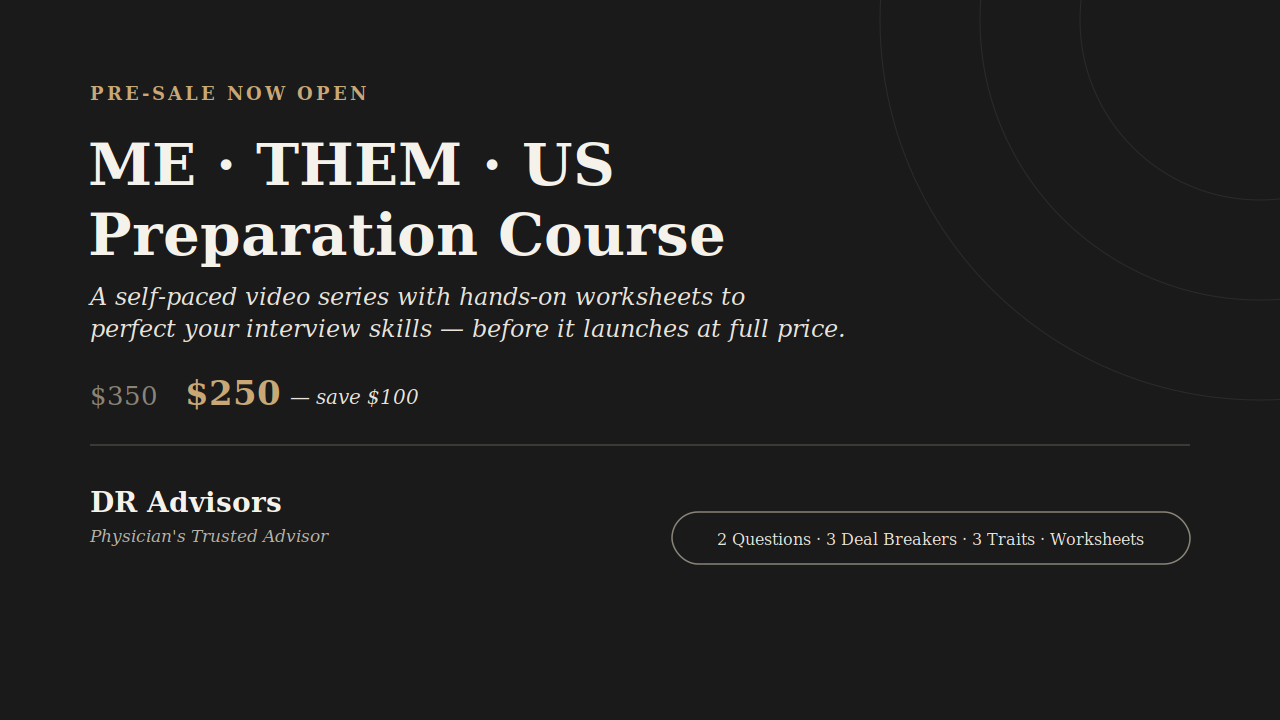
Preparation and energy. Get those two right and most of the rest is detail.
I was listening to Ryan Holiday describe how he prepared to go on Bill Maher's show, and what struck me was that he wasn't describing a media trick. He was doing almost exactly what I tell physicians to do before a job interview. He learned the person. He talked to people who had already been in that room. He decided what he wanted to say, practiced the hard parts, and thought about how he wanted to show up.
A few weeks later I was asked to teach residents in Glasgow, Kentucky how to interview for their first physician job — and while preparing for that session, I realized I was running the same process I want them to run.
It comes down to two ideas. Preparation. And energy. Everything below is the detail — and the full walkthrough is here if you would rather watch it.
The whole framework is in the free ME · THEM · US webinar — live with the prep guide included, or on-demand whenever you have the time.
"Good preparation is really about reducing the number of things you are encountering for the first time when it matters."
STEP ONE — STUDY THE HUMANS, NOT THE WEBSITE
Most candidates read the hospital website. That's fine. It is also where most candidates stop.
Read the bios of the people you are actually meeting. Look at LinkedIn. Search their names on YouTube and in podcasts. If the medical director or a VP has spoken publicly, give it a few minutes. You are not conducting an investigation — you are making the room feel familiar before you walk into it. There is a longer version of this in LinkedIn Isn't Stalking — It's Strategy.
I watched this decide a hire. We had a candidate who was not the frontrunner going in. The frontrunner came in and did well — nothing went wrong. But the other candidate had clearly done the work. At one point she brought up something relevant about one of our chief executives, and it changed the tenor of the whole room. The preparation itself communicated something: I care enough about this to invest before I even get here.
STEP TWO — KNOW THE ROOM BEFORE YOU'RE IN IT
Ask what the day actually looks like. One-on-ones or a panel? A dinner? A clinic tour? Who is at each part of the day?
For my Kentucky session I asked the program administrator what the room was like. That sounds trivial. It isn't. I once spoke to four people around a table, elbow to elbow — and because I knew in advance, I prepared the same content completely differently. That is not a PowerPoint room. That is a conversation.
Every surprise takes a little attention away from the conversation you actually want to have.
STEP THREE — DECIDE WHAT THEY SAY AFTER YOU LEAVE
When the people you met get together to discuss you, what do you want them saying?
Pick two or three things. That you're clinically strong. That you work well with a team. That you're committed to that community. That you have a specific clinical interest the practice needs. Then work backwards from there.
STEP FOUR — BRING PROOF FOR WHAT THE INTERVIEW CAN'T ASSESS
Identify the biggest concern the group is likely to have about you, then bring evidence that answers it.
We hired a surgeon from outside our organization even though we had two people we had trained internally. The hardest thing to establish about a surgeon in a conversation is whether they are actually a good surgeon. This candidate arrived with an outstanding recommendation from his program director that spoke directly to skill and to how he showed up in the program. It gave us credible evidence for the one thing the interview itself could not answer — and it moved him ahead of candidates we already knew.
So: what does this group most need to believe about me, and what can I bring that makes it easy to believe?
STEP FIVE — SAY IT OUT LOUD
Thinking through an answer is not the same as saying it. They sound completely different.
You can have an answer in your head that feels concise and sharp, then say it out loud and find it takes three minutes, has four side roads, and never answers the question. So speak your answers — your core stories, why you want the job, why that community, the parts of your background you know will come up.
Don't memorize. Just hear what your answer actually sounds like. That is also where confidence comes from — not from talking yourself into it, but from having already traveled the road a few times. More on that in You Prepared for Your Medical Boards. Did You Prepare for Your Physician Interview?
STEP SIX — PRACTICE THE QUESTION YOU HOPE THEY DON'T ASK
Don't only rehearse the easy ones. What is the question you are hoping to avoid? Why are you leaving? Why this location? Why did you change programs? What are your salary expectations? What's the gap on your CV?
Say that answer out loud before the interview. The point is not to sound rehearsed. The point is that the first time you hear yourself answer the hardest question should not be while five people wait for it.
STEP SEVEN — DECIDE YOUR ENERGY
Early on I thought these moments were about the words. The longer I do this, the more I believe that how you say it shapes how the words land.
Residents and fellows often walk in trying to look as experienced as the person across the table. You will never win that game — they may have twenty years on you. So bring what is actually yours: preparation, curiosity, and the quality of being someone people can picture working with.
That doesn't mean walking in artificially amped up. It means deciding how you want to show up, then clearing away the things that drain it. Know the route. Know the schedule. If there's an interview dinner, look at the menu beforehand so you aren't choosing a meal while three people ask you questions.
Before your next interview, answer these in writing:
-
Who are the people I am meeting, and what do I know about each of them that isn't on the website?
-
What does the day look like — format, rooms, meals, who is in each part?
-
What are the two or three things I want them saying about me after I leave?
-
What is their biggest likely concern about me, and what proof am I bringing for it?
-
What is the question I hope they don't ask — and have I said my answer out loud yet?
You cannot control how every person responds to you. You can prepare enough that you are not spending your energy on things you could have solved the night before. And you can decide what you bring into the room.

There are two questions you will be asked in every physician interview, three mistakes that quietly take you out of the running, and three things the interviewer needs to believe about you before they make an offer. I walk through all of it in the free ME · THEM · US webinar. Come to the live session and the full prep guide is included, or take the same material as a short video series and watch it between cases — either way it costs nothing, and you leave with the framework rather than a list of tips.
DR Advisors · Physician's Trusted Advisor · Part of the ME · THEM · US Series
Related reading: LinkedIn Isn't Stalking — It's Strategy: How Physician Candidates Can Research Interviewers | Find the One Impressive Thing: How Physician Candidates Can Turn Interview Prep Into Real Connection | You Prepared for Your Medical Boards. Did You Prepare for Your Physician Interview?