LinkedIn Isn't Stalking — It's Strategy: How Physician Candidates Can Research Interviewers Before a Site Visit
Jun 09, 2026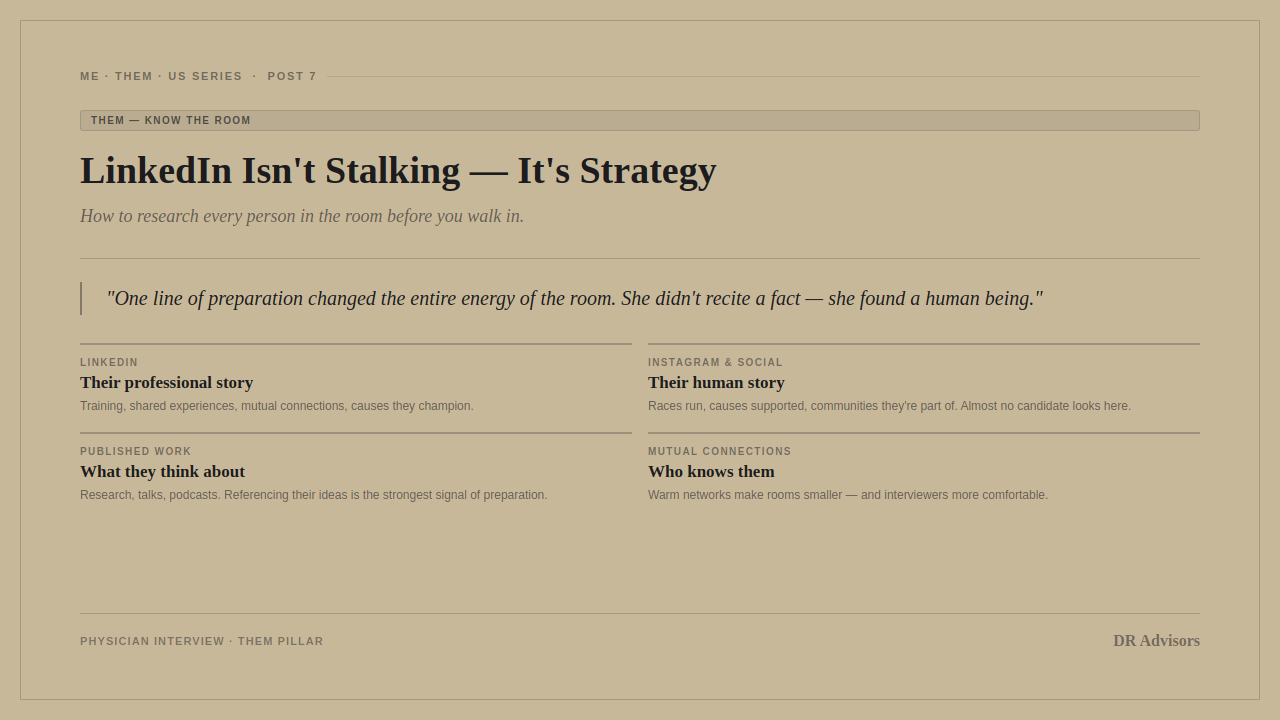
LinkedIn Isn't Stalking — It's Strategy: How to Research Every Person in the Room Before You Walk In
I want to tell you about a moment I watched happen in an interview room that I have never forgotten.
A candidate was meeting with our medical director. The conversation was going well — she was prepared, articulate, clearly qualified. And then, almost offhandedly, she mentioned that she had seen the medical director had run a 10K that our health system had sponsored. She had run it too. She framed it as an observation about the organization's community involvement — thoughtful, not sycophantic — and moved on.
The medical director's face changed. Not dramatically. But visibly. Something that had been a professional conversation became, in that moment, a human one. The energy in the room shifted. She got the offer.
"One line of preparation spoken changed the entire energy of the room. She didn't recite a fact — she found a human being. That's what great THEM research actually looks like."
This is what I mean when I say: know the people you are meeting before you walk in. Not to impress them with a list of their accomplishments. Not to recite their CV back to them. But to find the human connection that exists before the interview even starts — and bring it into the conversation naturally.
That is the difference between research and strategy. Research collects information. Strategy uses it to build a relationship.
WHERE TO LOOK — AND WHAT TO LOOK FOR
LinkedIn — Their professional story Where did they train? What have they built? What do they post about and engage with? Look for shared experiences, mutual connections, and the causes or topics they clearly care about. This is your starting point for every interviewer on your schedule.
Instagram and Social — Their human story Public social profiles reveal what people are proud of outside the office — races they've run, causes they support, communities they're part of. This is where the most powerful human connections live. And almost no candidate thinks to look here.
Published Work — What they think about Research, op-eds, conference talks, podcast appearances — if your interviewer has put ideas into the world, read them. Referencing a specific argument or finding they've made is one of the most credible signals of preparation you can give.
Mutual Connections — Who knows them? A shared colleague or mentor is worth a brief, genuine mention. Warm networks make rooms smaller — and interviewers more comfortable. Use them when they're real.
You may be thinking: How do I avoid making this seem weird?
If you would rather not build this alone, here are the three ways I work on interviews: the course, a mock interview, or one-on-one coaching.
HOW TO USE IT WITHOUT OVERDOING IT
There is an art to deploying research in an interview. The goal is never to demonstrate how much you know — it's to open a door to a genuine conversation. One well-placed, naturally framed observation lands far better than a rehearsed list of facts.
Frame it as an observation, not a fact check. "I noticed your group has been really active in the community — the 10K sponsorship stood out to me." Not: "I saw that on your Instagram."
Connect it to something genuine about yourself. The candidate ran the same race. The connection was real, not manufactured. Authenticity is what makes it land.
Use it to open a question, not close a topic. "I'd love to hear more about how the group engages with the community beyond the clinical work."
One strong connection beats five surface-level ones. Go deep on the most meaningful thing you found rather than listing everything you discovered.
The physicians who do this work are not trying to manipulate the room. They are doing what any thoughtful professional does before an important meeting — they are learning about the people they are about to spend time with.
Be one of the ones who is serious. Look them up. Find the human connection. Bring it into the room like it's the most natural thing in the world — because it is.
We have developed the Me / Them / Us Framework for Physician Interviews to walk physicians through a process that will have them fully prepared for the interview.
The interview is not a test you pass. It is the first conversation with people deciding whether they want you in the room for the next ten years, and the physicians who do it well walk in already sounding like a colleague who simply hasn’t started yet. That is what ME + THEM = US is for: know what you want, know who you are meeting, and say out loud where the two meet. If you want to work it that way, there are three ways to do it with me — the preparation course at your own pace, a mock interview to test it, or coaching where we build the whole thing together.
One line of preparation changed the energy of an entire interview. One offer followed. That's the THEM work. And it's available to every physician willing to spend the time.
DR Advisors · Physician's Trusted Advisor · Part of the ME · THEM · US Series
Related reading: How to Research a Health System Before Your Physician Site Visit | Find the One Impressive Thing: How Physician Candidates Can Turn Interview Prep Into Real Connection | The Physician Interview Questions That Make You Look Like the Right Candidate