
The Year 2 Trap: Why Physicians Earn Less Than They Expected — And How to See It Coming
Jul 08, 2026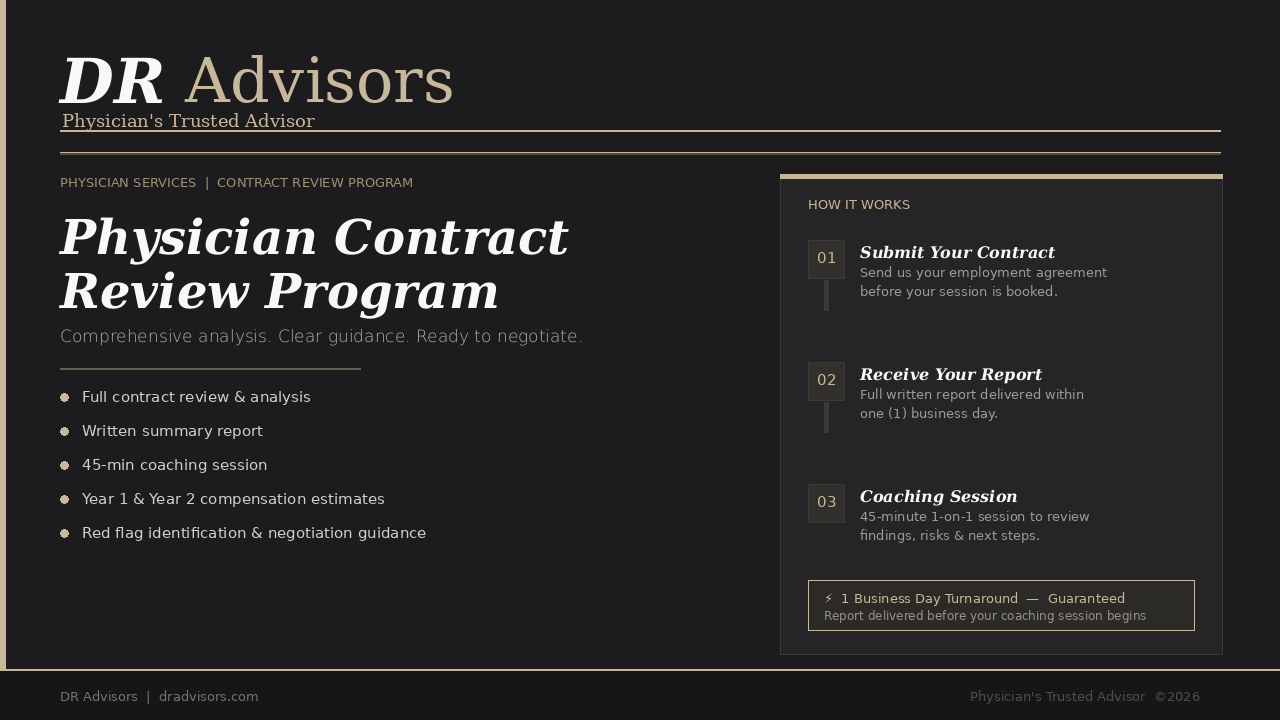
By DR Advisors | Physician's Trusted Advisor
He called us in month ten of his first attending position. His draw period was ending in sixty days, and he'd just done the math for the first time.
The numbers didn't add up the way he'd expected. His patient panel was building — slowly, but normally for his specialty. The problem wasn't his performance. It was the formula. The wRVU threshold in his contract was set at a level that assumed a fully built panel from day one. At his current productivity, his Year 2 income was going to be roughly $40,000 less than Year 1.
He wasn't in trouble. But he was blindsided — and he didn't have to be.
What the Year 2 Trap Looks Like
The Year 2 trap isn't a single clause. It's a combination of factors that interact in ways most physicians don't anticipate when they sign:
1. The draw period ends. Most contracts guarantee a base salary or draw for Year 1 — sometimes Year 2 — while a physician's patient panel builds. When that period ends, compensation shifts to a productivity model. If the panel isn't fully built, the income follows.
2. The RVU threshold is set too high. The threshold — the number of wRVUs you need to hit before your productivity bonus kicks in — is often benchmarked to a fully established physician, not a new hire still growing a panel. The gap between where you are and where the threshold sits can be significant.
3. The conversion factor doesn't compensate for the gap. Even when physicians exceed the threshold, the conversion factor — the dollar amount per wRVU — determines how much each additional unit of work is worth. A low conversion factor means you have to work harder to make up for a late start.
4. Non-clinical obligations eat into productivity. Call requirements, administrative duties, committee work, and electronic health record burden all reduce the clinical hours available to generate wRVUs. Many new physicians don't account for how much of their time is consumed before they see a single patient.
Have a question this post did not answer? Bring it to a free fifteen-minute call — interviewing, negotiating or contracts.
How to See It Coming Before You Sign
The Year 2 trap is entirely predictable — if you know what to look for. Here's the framework:
Model it before you sign. Take the wRVU threshold in your contract and compare it to realistic productivity benchmarks for your specialty and a panel of your anticipated size. MGMA and AMGA publish benchmark data. A professional contract review includes Year 1 and Year 2 compensation estimates for exactly this reason.
Understand the threshold and the conversion factor together. A high threshold with a strong conversion factor is different from a high threshold with a weak one. What matters is the combination — how hard you have to work and what you earn for it.
Negotiate the draw period if the threshold is aggressive. If the wRVU threshold is benchmarked to a fully established physician and you're coming in as a new hire building a panel, a longer guaranteed draw period or a step-down threshold that adjusts in Year 2 is a reasonable ask — and often more negotiable than physicians expect.
Factor in your non-clinical obligations. Before you model your productivity, account for the hours your contract requires outside of direct patient care. Call burden, administrative duties, and any non-clinical obligations reduce your available clinical time and should be reflected in your productivity projections.
Expert Advice: The Year 2 conversation is one of the first things we cover in every contract review — because it's where the most significant financial surprises live, and because it's entirely preventable. The physicians who get caught off guard aren't the ones who didn't try. They're the ones who didn't have someone model it out with them before they signed. That's a solvable problem.

The Bottom Line
The Year 2 trap isn't inevitable. It's predictable — if you understand the formula, model the numbers, and negotiate the right provisions before you sign. The time to have that conversation is before you commit, not sixty days before your draw period ends.
Related reading: Your Salary Isn't Just Your Salary: How Physician Compensation Really Works | The 5 Contract Questions Every Physician Should Be Able to Answer Before Signing | The Physician Contract Review Program: What It Is, How It Works, and Why It Matters