
The Process Was Broken Before Anyone Started — Building the Checkout Workflow
Aug 03, 2026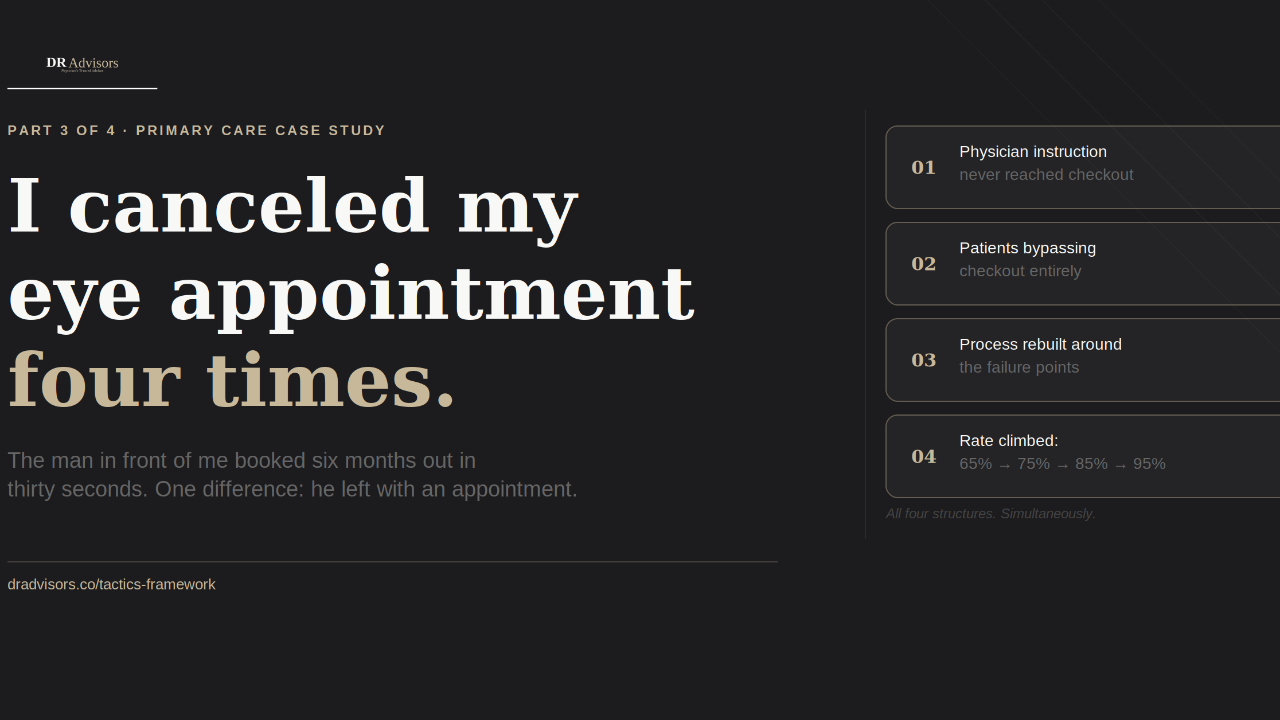
Part 3 of 4 — Primary Care Case Study: Process Flow Review
The story that crystallized everything:
During the period we were working on the patient retention program, I had an eye appointment on a Thursday morning. Not at the beginning of the day — later. Once my day started, it filled up fast, and I had to cancel. I rescheduled for a couple of hours later. Walked past the eye doctor's office on the way to a meeting. Walked past it again on the way back. Rescheduled again. By the end of the next day I had canceled that appointment four times. I finally made it on the fifth attempt — right before the Friday afternoon meeting with our management team to review progress on the reappointment program.
While I was waiting, the man ahead of me finished his visit. The front desk asked if Friday afternoon in six months worked for him. He said that was always his best day. They booked it. He left in thirty seconds. That man has probably never missed an appointment in years. I canceled four times in less than twenty-four hours at the same practice. The only difference between his outcome and mine was that his next appointment was made before he walked out the door. Mine wasn't — and I spent the rest of the day trying to find a window that my schedule would hold.
That's the patient experience on both sides of a checkout process that works and one that doesn't.
And it was exactly what was happening in our primary care practice — except at scale, across hundreds of patients every day, without anyone able to see it because there was no system tracking it.
What the process review found
By the time we began the process flow review, the team was bought in. Staff understood the why, ownership was assigned, and the accountability structure was in place. But the reappointment rate was still stuck. It had moved — 60% to 65% — but it wasn't climbing the way the data said it should if the rebook was actually happening consistently.
We went back into the process. Not the conversations around it — the actual workflow.
What happened from the moment a physician finished a visit to the moment the patient walked out the door? Two gaps surfaced immediately.
Gap one: The physician's follow-up instruction wasn't reaching checkout. When a physician told a patient to come back in three months, that information stayed in the exam room. There was no handoff — no note, no flag, no system notification — that communicated the instruction to the person at checkout. The checkout team had no way of knowing a follow-up was needed unless the patient mentioned it themselves. Most patients didn't.
Gap two: Some patients were bypassing checkout entirely. The clinic layout and patient flow meant that a portion of patients — particularly those in a hurry or those who believed their visit was finished — were walking straight out of the building without stopping at the checkout desk. No rebook could happen for a patient who never went through the step. These weren't awareness problems. The team knew rebooking was the goal. They were structural problems — gaps in the physical and informational flow of the visit that made consistent rebooking impossible regardless of how motivated the staff were.
The fix
Both gaps required different solutions at different levels of complexity. The handoff gap was solved through a combination of documentation and workflow redesign. The physician's follow-up instruction needed to be visible to the checkout team before the patient arrived at the desk. We built a simple communication pathway — actually a couple of options depending on physician preference — so that checkout knew what appointment to make before the conversation started. The physician barely had to do anything extra. The instruction they were already giving the patient now traveled with the patient to the desk.
The bypass gap required a physical and procedural change. Patient flow was adjusted so that checkout was a required stop, not an optional one. For patients who had been bypassing the step, the path out of the clinic now moved through checkout by design rather than relying on the patient to choose to stop. Neither fix was expensive. Neither required new technology. Both required a manager willing to observe the actual workflow, identify where it broke down, and redesign the steps around the failure points rather than around the assumption that the process was working.
The climb The reappointment rate didn't jump from 65% to 95% when these fixes went in. It climbed — 65% to 70%, 70% to 75%, 75% to 85% — as each barrier was identified and removed.
That's what a real process review looks like. It's not a one-time audit that produces a report. It's an ongoing diagnostic process where the data tells you each week how far you've come and what's still in the way.
When the rate stalled at 70%, we went back into the process and found the next thing blocking it. When it stalled again at 80%, we did it again.
Each step required the same combination: look at the data, engage the team to understand what they were seeing, identify the specific process gap, design the fix, implement it, and watch the number move. The team's involvement was essential at every stage — not because the manager couldn't have diagnosed the gaps alone, but because the staff closest to the work knew things the data didn't show.
What comes next
The process fixes made consistent rebooking possible.
The accountability structure made it visible — in real time, every day, at a level of detail that let the team and management see exactly where they were and who needed to be called back.
Part 4 of this series covers the reporting system we built: a daily and weekly reappointment rate report that gave us the data to track the climb, identify who had fallen out of the schedule, and hold the process accountable in short enough intervals that problems didn't compound before anyone noticed them.
The process review is one of four structures the TACTICS Framework builds inside your organization. Book a free strategy call