
How to Get a Team to Actually Change — Staff Engagement in a Real Practice
Jul 27, 2026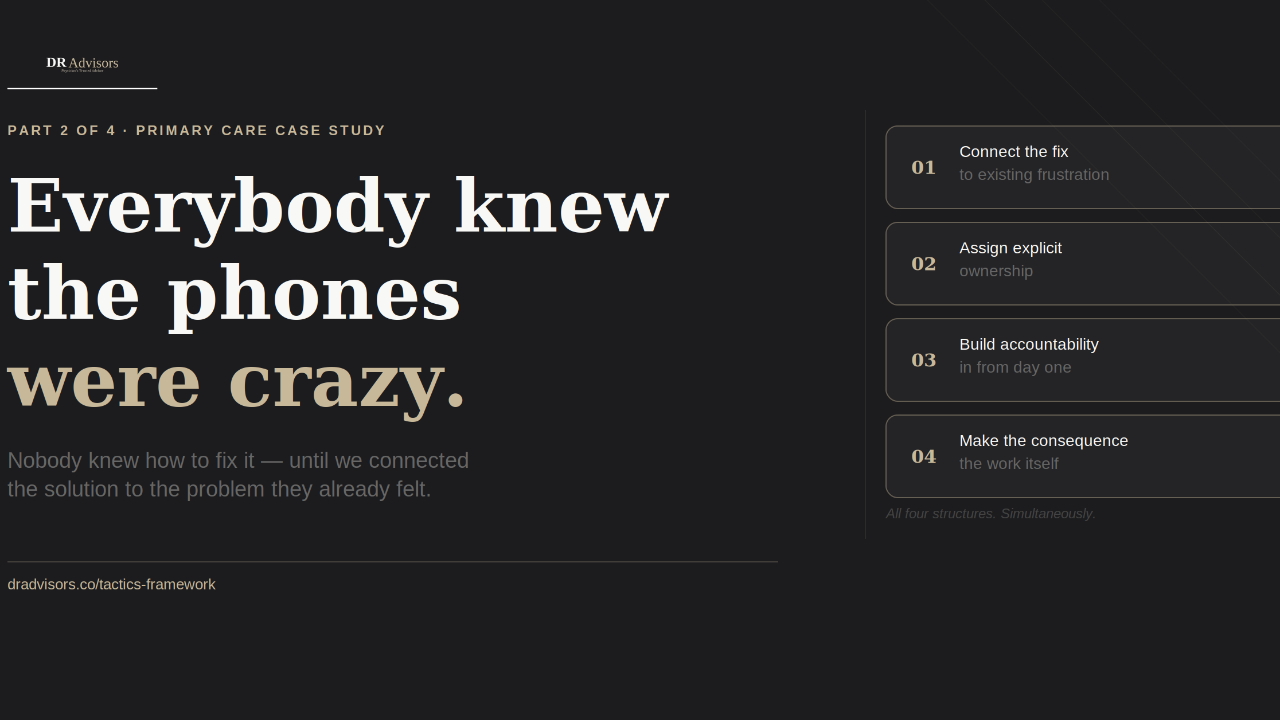
Part 2 of 4 — Primary Care Case Study: Staff Engagement
The gap between knowing and doing By the end of the Physician Operator Review we covered in Part 1, the diagnosis was clear: nobody was rebooking patients at checkout.
The follow-up appointment wasn't being made before the patient left the building. That single gap was generating a flood of inbound calls, overwhelming the phones, and creating a refill and scheduling crisis that looked like a staffing problem.
Knowing the root cause doesn't fix anything. The next question is always harder: how do you get a team to change a behavior they've never been asked to do before, in the middle of a busy clinic day, consistently enough for the change to actually show up in the data? In this practice, two things made the difference.
Make the fix feel like relief, not work.
The single biggest driver of staff engagement in any change program is whether the change makes their day better or worse. A process improvement that adds steps and feels like more work will be quietly abandoned within weeks — not because the team is resistant, but because operational pressure always wins over new habits that don't have an obvious payoff.
In this case, we had an advantage: everybody already knew the problem. The phones were out of control. Messages were piling up. Staff were constantly scrambling to fit patients in at the last minute. The frustration was real, visible, and shared across the whole team. When we brought the rebook-at-checkout solution forward, we didn't frame it as a new performance requirement. We framed it as the answer to the problem they were already living with.
We walked the team through the same chain we'd worked through in the Physician Operator Review: this is why the phones are ringing, this is why you're fielding refill requests all day, this is why you're squeezing people into spots that don't exist. And then: this is how we stop it. The reappointment process wasn't going to add work to their day. It was going to eliminate the work they hated most. That reframe changed the conversation. The team wasn't being asked to do more — they were being handed the solution to work that was already exhausting them.
Make ownership explicit and build accountability in from day one.
Connection to the problem gets buy-in. Explicit ownership makes it stick.
We didn't suggest that staff should try to rebook patients when possible. We assigned it. Every patient who needs a follow-up leaves with an appointment. That's the standard. Not a goal, not a best practice — the expectation. The accountability structure was simple and immediate.
We tracked reappointment rates and made the number visible to the team. If the rate was at 95% or above, the work was done. If it was below 95%, the team worked the phones — calling patients back and getting them scheduled at the right intervals. The consequence wasn't discipline. It was more of exactly the work the process was designed to eliminate. That alignment — do the rebook now or do more phone work later — made the logic of the standard impossible to argue with.
Accountability without visibility doesn't work. We'll cover the specific reporting in Part 4 of this series. But the key point for staff engagement is that the metric existed from the beginning, the team knew what it was, and everyone could see whether the process was holding.
What happened
The team responded better to this program than almost anything else we implemented in that practice. Not because the change was easy, but because it was the right change — one that reduced the daily friction they'd been absorbing for months without a solution.
The reappointment rate started moving almost immediately. Not from 60% to 95% overnight — that took months of incremental work as we found and fixed each barrier in the process. But the direction was clear from the first week, and the team could see it in the data.
- When the phones got quieter, they felt it.
- When the schedule started filling from rebooks instead of inbound calls, they noticed.
The feedback loop between the behavior and the result was fast enough to reinforce the change. That's the difference between staff engagement that lasts and staff engagement that fades. When the team can draw a direct line between what they changed and what got better — in their own day, not just in a quarterly report — the behavior becomes self-sustaining.
What comes next
Staff engagement got the behavior started. But the process itself had gaps that buy-in alone couldn't solve. Physicians were communicating follow-up instructions to patients, but nothing was passing that information to the checkout team. Some patients were bypassing checkout entirely. The rebook was supposed to happen at the end of every visit — but the workflow didn't make it happen automatically.
Part 3 of this series covers the process flow review: how we mapped the gaps, categorized what could be fixed immediately versus what required a more structured implementation, and built a checkout workflow that made consistent rebooking possible regardless of how busy the day got.
The TACTICS Framework builds the staff engagement structure — and the three that surround it — inside your organization. Book a free strategy call