
Green Flag / Red Flag: Reading a Physician Opportunity
Oct 16, 2026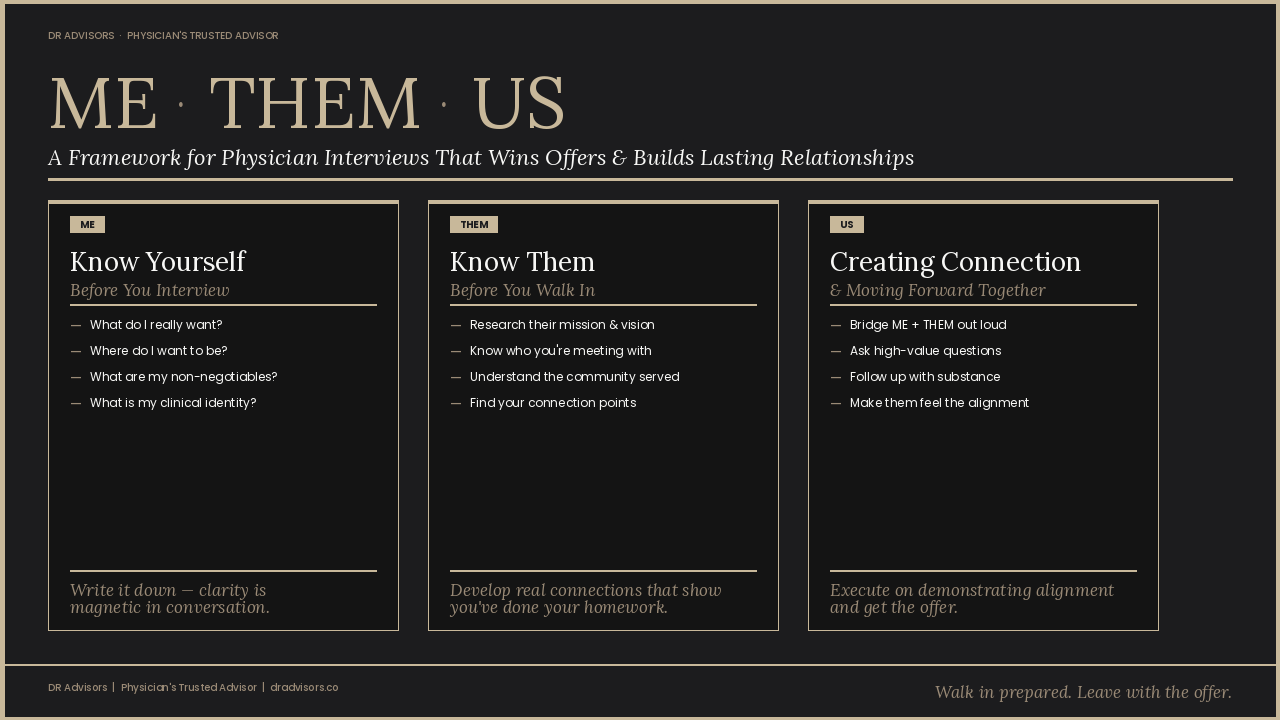
They are evaluating you. You are also evaluating them, and almost nobody prepares for that half.
There is a lot of advice about the red flags in a physician contract. There is almost none about the green ones.
That is a real gap, because the negative list only tells you what to fear. It never tells you what a good opportunity actually looks like when you are standing in it — and if you cannot recognize the good version, you cannot tell the difference between a group worth joining and a group that simply hid its problems well.
So here are the signals, in the order you will meet them: in the interview, on the site visit, when the offer arrives, in the compensation model, and in the contract itself. Some of these I have been on the other side of.
The whole framework is in the free ME · THEM · US webinar — live with the prep guide included, or on-demand whenever you have the time.
"Nobody plans logistics for a candidate they're about to pass on."
WHILE YOU ARE IN THE INTERVIEW
Green: they start asking about your start date. Nobody plans logistics for a candidate they are about to pass on.
Green: the conversation runs long. Nobody gives away time they did not plan to give.
Green: you get introduced to someone who was not on the schedule. Somebody is building a case for you while you are still in the building.
Red: every question is read off a list, verbatim. That is not a conversation, and it is very hard to be memorable inside a checklist.
Red: they only talk about what they need and never about what you want. That is a preview of what the relationship will feel like.
Red: nobody mentions next steps. Not necessarily bad — but ask before you leave the room.
Worth knowing: the questions you ask are being read the same way.
READING THE ORGANIZATION ON THE SITE VISIT
Green: the longest-tenured physician has been there fifteen years. Nobody stays somewhere bad for fifteen years.
Green: you are left alone with physicians, no administrator in the room. That is confidence — and I say that .
Green: someone names a problem they are actively working on. It is the most honest thing you will hear all day.
Green: the people interviewing you disagree with each other in front of you. Healthy groups can disagree openly. Unhealthy ones can't.
Red: nobody can say why the last person left. They know. They are choosing not to say.
Red: every answer about culture is a slogan. "We're like a family" is not information. There is a fuller treatment of this in How to Read a Physician Group's Culture Before You Commit.
Red: physician leadership has no real authority. Ask what decisions physicians actually make.
WHEN THE OFFER IS ON THE TABLE
Green: the offer comes with an explanation of how they got to the number. Transparency in the structure now usually means transparency later.
Green: they put a verbal agreement in writing without being asked. This is the best single predictor I know of how a group will handle the next thing, and the thing after that.
Green: they tell you which parts have flexibility. That is somebody negotiating with you, not at you.
Red: a low first offer. Not automatically a bad employer — but know what is happening.
Red: "we need an answer by Friday." Ask what happens if you need until Wednesday, and watch the reaction.
Red: every single item becomes a fight. I have rescinded an offer over this. At some point it stops being about the contract.
IN THE COMPENSATION MODEL
Green: base plus production, with a threshold you can actually clear. That is upside you can reach.
Green: they know what a typical physician there actually produces. Somebody is tracking it, and they are not hiding it.
Green: year two expectations written down somewhere. Year two is where the surprises live.
Green: someone walks you through a real example calculation. Numbers on paper beat assurances.
Red: base only, in a practice that is clearly growing. I have watched a workload double while the number stayed flat.
Red: they will discuss the rate but never the volume. The rate is the smaller half of the equation.
Red: the bonus formula takes three explanations to understand. If they can't explain it simply, you can't predict it.
IN THE CONTRACT ITSELF
Green: tail insurance, employer pays. Real money they are absorbing for you.
Green: ninety-day notice, and it says what happens to your pay. Most contracts don't say.
Red: a non-compete with no geographic limit, where nobody can tell you what it restricts.
Red: "schedule determined by employer," with no boundaries. Some flexibility is fair. Unlimited isn't.
The contract-side list runs deeper in The Red Flag Checklist.
Before your next site visit, answer these in writing:
-
Who is the longest-tenured physician in this group, and have I asked why they stayed?
-
Do I know why the last person in this role left — and did the answer sound real?
-
What problem did someone here admit to me, unprompted?
-
Can I explain their bonus formula back to them in one try?
-
What decisions do physicians here actually make, and who told me so?
None of these is decisive on its own. They accumulate. And the useful habit is simply this: walk in intending to collect signals rather than only to give them.

There are two questions you will be asked in every physician interview, three mistakes that quietly take you out of the running, and three things the interviewer needs to believe about you before they make an offer. I walk through all of it in the free ME · THEM · US webinar. Come to the live session and the full prep guide is included, or take the same material as a short video series and watch it between cases — either way it costs nothing, and you leave with the framework rather than a list of tips.
DR Advisors · Physician's Trusted Advisor · Part of the Green Flag / Red Flag Series
Related reading: How to Read a Physician Group's Culture Before You Commit | The Physician Interview Questions That Make You Look Like the Right Candidate | The Red Flag Checklist: 7 Contract Provisions That Should Stop You in Your Tracks