
Why Patient Retention Programs Fail — and the Four Things You Need Before You Start
Jul 13, 2026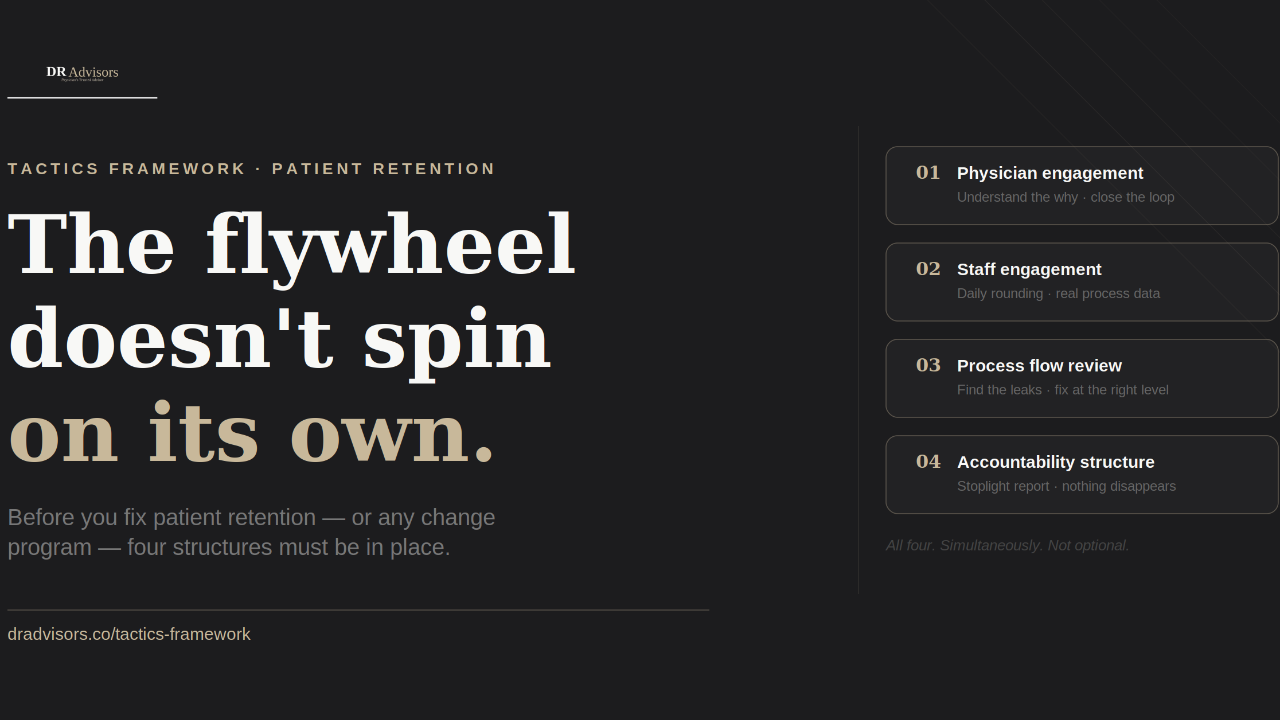
The data that changed everything
When I ran a surgical specialty physician group, the conventional wisdom in the building was simple: new patients are the lifeblood of the practice. More new patients meant more surgeries, more revenue, more growth. Nobody had ever questioned it — and so nobody ever had.
So I questioned it. I pulled the data and ran a simple analysis: what was a new patient actually worth in the first six months, compared to an established patient in the same window?
The answer was alarming. New patients were generating roughly one to two visits in a six-month period — and no surgeries. The timeline from first visit to surgical case was significantly longer than the team believed. Meanwhile, established patients further along the care journey were producing far more: follow-up visits, diagnostics, referrals, and procedures. The care plan was actually executing.
We had been obsessing over the front door while patients quietly walked out the back. The retention flywheel was leaking — and we were paying to bring in new patients to replace the ones we were losing, instead of building the system that would keep them.
That data changed our strategy. But the data wasn't the hard part. The hard part was building the infrastructure to actually fix it.
Why change programs fail in physician groups
Most health systems know what their retention problem is. The real issue is that they try to fix it without the infrastructure to make the fix stick.
I've watched this happen with retention programs, meeting cadence overhauls, administrative burden reduction initiatives, and physician engagement efforts. The pattern is always the same: a real problem is identified, a solution is designed, and six months later nothing has changed. The initiative quietly died under operational pressure.
The reason is almost never the quality of the idea. It's the absence of four reinforcing structures that have to be in place before any change program can produce sustainable results inside a physician group.
These aren't sequential steps. They're not a checklist you work through in order. They're interdependent systems that have to run simultaneously — because if even one is missing, the others can't hold the change in place.
Structure 1 — Physician Engagement
Physicians have to understand why the change is happening. But understanding the rationale isn't enough on its own — the programs that actually produce durable results are the ones where the change is solving problems physicians themselves identified.
When physicians see their own feedback driving the solution, engagement is automatic. They're not buying into your program — they're watching you execute on theirs.
In our patient retention work, this meant the problem surfaced through the Physician Operator Review — a structured monthly meeting where physician concerns are on the agenda, tracked, and followed through to resolution. When physicians told us patients weren't being rebooked consistently, or that front desk handoffs were breaking down, we documented it, assigned ownership, and brought the status back the following month. Physicians stayed engaged because they could see their concerns moving through a visible accountability process.
The mechanism has two channels: the formal monthly Operator Review for data-driven tracking, and real-time communication through manager rounding and formal email follow-up for issues that can't wait a month. When a physician raises a concern in a hallway, they get a documented response. Nothing disappears.
The principle: Physicians trust leadership when they watch their feedback get acted on, month after month. Physician engagement isn't a launch event. It's an ongoing communication system.
Structure 2 — Staff Engagement
Staff are where the retention process either works or breaks down. The front desk that doesn't consistently rebook. The medical assistant who doesn't complete the follow-up call. The scheduler who lets a slot stay empty rather than flagging it. Each of these is a leak point — and they add up fast.
Real staff engagement in a change program means three things. First, connect the change to their actual daily work so they understand why it matters to them personally, not just to the organization. Second, involve them in the process redesign — they're the ones living with the current process and they know exactly where it's broken. Third, show them the results when it's working. When the no-show rate drops and the schedule fills, make sure the team sees it.
The mechanism is daily rounding. Not as a performance check — as a conversation. Managers following staff through their actual work, asking questions designed to surface friction rather than compliance, listening for where the day gets hard. That's where the real process data lives. What looks like a staffing problem from the director's desk often turns out to be a three-click workaround someone built six months ago and never reported.
The principle: Staff engagement and process discovery happen through the same activity. Rounding isn't just a communication tool — it's the primary source of operational intelligence for a change program.
Structure 3 — Process Flow Review
Most patient retention problems aren't about clinical care quality. They're about the operational process wrapped around the care — rebooking that isn't systematic, lab follow-up that falls through the cracks, handoffs between clinical staff and front desk that break down under volume pressure.
The process flow review identifies exactly where patients are exiting the loop and why. In a retention program, this means tracing the entire patient journey from appointment to checkout to rebook to follow-up — and finding every point where the process depends on someone remembering to do something, rather than a system that makes it happen automatically.
The key is categorizing what you find. Small friction points — a sign missing on a door, a verbal script that's inconsistent between staff, a checkout step being skipped under pressure — get fixed immediately during rounding. Bigger changes — EMR workflow adjustments, scheduling system redesigns, staffing model changes — enter the formal improvement project structure. They get a named owner, a target date, and a status on the monthly stoplight report. They stay visible and tracked until they're resolved.
The principle: Nothing gets fixed by talking about it once. It gets fixed when it has an owner, a timeline, and a place on a report that gets reviewed publicly every month.
Structure 4 — Accountability Structure
This is where most change programs die — not because the solutions were wrong, but because there was no system to keep the work visible once operational pressure rose.
The accountability structure in the TACTICS Framework is built around the stoplight report: a simple, publicly reviewed tracking system where every open improvement project has a status. GREEN means resolved. YELLOW means in progress with a named owner and target date. RED means escalated — leadership intervention is required and a written escalation has gone to the next level.
The stoplight report is reviewed at every monthly Physician Operator Review with physician leaders in the room. This is intentional. When physicians see their concerns on the agenda, tracked to resolution, and escalated when they're stalled — they trust that the organization follows through. That trust is what sustains physician engagement across an 18 to 24 month program.
The accountability structure also defines the communication plan: what gets documented, what triggers a formal email, when an issue escalates from a manager to a director to a VP. Not because of consequences — because visibility is what keeps change alive when the next operational priority tries to push it off the agenda.
The principle: Accountability isn't surveillance. It's the structure that makes change visible enough to survive.
These four structures are not a patient retention strategy. They are the prerequisite.
Patient retention is how we make this concrete — because it's one of the clearest places to see all four structures at work simultaneously. Physicians engaged around a problem they identified. Staff involved in redesigning the process they execute. A process flow reviewed and fixed at the right level. An accountability structure that keeps every open issue visible until it's resolved.
But the TACTICS Framework applies this infrastructure to every change program a physician group attempts. Meeting cadence. Administrative burden. Onboarding. Compensation transparency. Scheduling access. The four structures don't change — only the problem they're applied to.
If you're missing even one of these, the program will revert the moment operational pressure rises. The flywheel won't spin because there's nothing holding it in place.
In the next post, we'll walk through a real example: a primary care group that came to us with an operational problem. Patient retention wasn't what they thought it was — and what we found changed the entire direction of how we built the program.
Ready to build this infrastructure inside your organization? The TACTICS Framework is a complete leadership operating system built specifically for hospital-employed physician groups.