
What the TACTICS Framework Is — and Why We Built It
Jul 09, 2026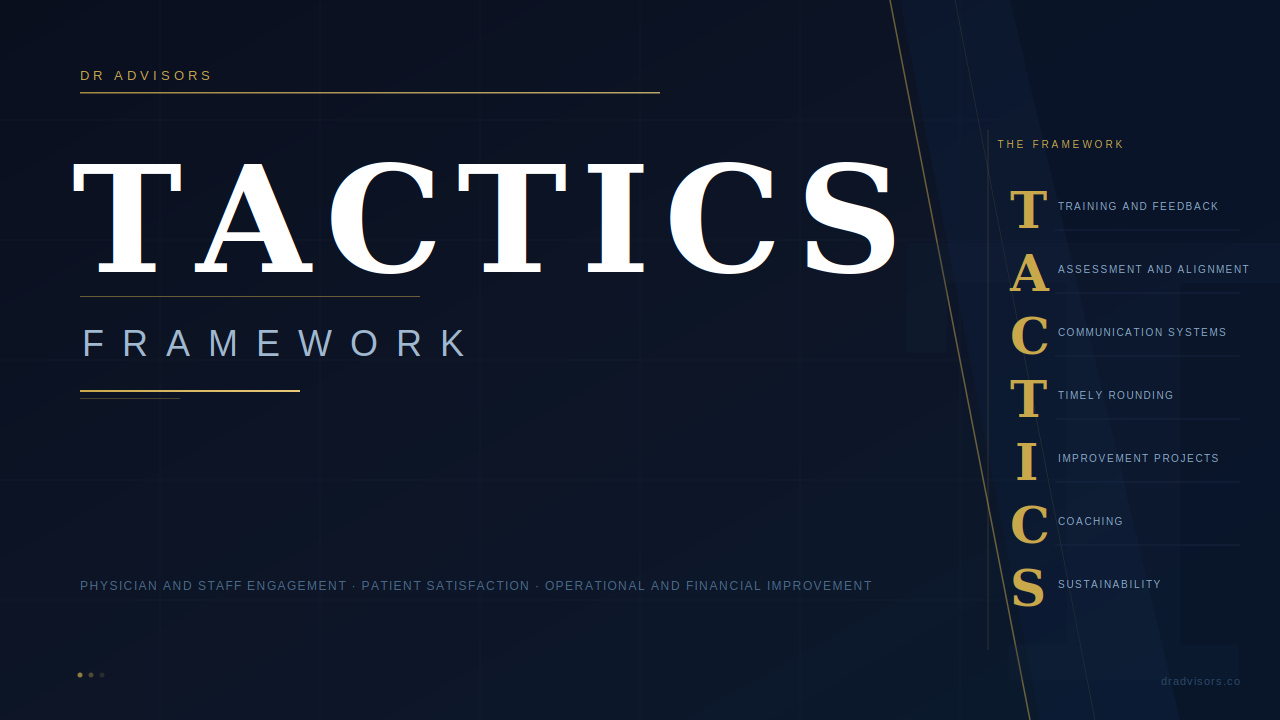
Not sure where your organization stands? Book a Free Strategy Session
I wasn't far into my new role when I got a call from one of my directors. Two front office employees had gotten into it — a real argument, spilling out into the clinic hallway. HR was already involved, which was the right call.
Then the front office staff member walked into my office.
Not her manager's office. Mine. Which was across the building from the clinic. She'd made that trip on purpose.
She came in upset, explaining what had happened, getting increasingly worked up — then calming down, then worked up again. My two directors were in the office with me. I watched them respond to her the way most people would: Oh my gosh, I can't believe that. That's terrible. They were swept in. She was convincing.
When I finally got her out and the door closed, I looked at both of them and said: there is no way that story is true. Did you watch how she was performing that? The way the hysteria came and went on cue?
They were surprised. I wasn't.
What I was watching was a staff member who had learned — through experience — that if you go straight to the top and make it dramatic enough, you get what you want. The chain of command didn't hold in that organization. Leadership had no consistent process. So people filled the vacuum with whatever worked. And for years, this had worked.
When HR finished the investigation, it turned out she was the aggressor. Both employees were terminated that afternoon.
That moment wasn't an HR story. It was a leadership system story. And it's the reason the TACTICS Framework exists.
The Real Problem Isn't the Physicians. Or the Staff.
When health systems call me about physician dissatisfaction, they usually describe it as a people problem. The physicians are difficult. The staff turnover is high. The culture is toxic. What they're actually describing is a system with no chassis.
Think about building a car. You can have the best engine, the best seats, the best electronics — but without a chassis, none of it holds together. You can't bolt parts to air. Everything just falls.
That's what most employed physician groups are operating with. Good people — often excellent clinicians and capable administrators — trying to work in an organization that has no structural framework to hold communication, decisions, accountability, or trust in place. And when there's no structure, informal power fills the gap. Staff go around their managers. Physicians go around their directors. Everyone escalates to the top because that's where decisions actually get made. And the CEO, trying to keep people happy, becomes a pop-off valve for problems that should have been resolved three levels down.
I've watched this pattern play out in organization after organization. It's not a coincidence. It's what happens in the absence of structure.
TACTICS was the playbook we built to fix it.
What TACTICS Is
TACTICS is a leadership operating system for hospital-employed multispecialty physician groups. It's not a survey platform. It's not a retreat. It's not a motivational program. It's a structured framework — a chassis — that gives your organization something to bolt everything else onto.
We developed it over years of working inside health systems, watching what worked and what didn't. The core insight was simple: most physician engagement problems aren't physician problems. They're communication and accountability problems that live in the leadership layer. Fix the leadership system, and physician engagement follows.
The framework has seven integrated components. Each one addresses a specific lever. Together, they work as a system. Learn more about the full framework at DRAdvisors.co →
T — Training & Feedback. Clinical expertise doesn't automatically translate into leadership effectiveness. Most managers and directors in employed groups were promoted because they were operationally strong — not because they knew how to lead physicians, navigate conflict, or build trust across a difficult power dynamic. We close that gap with structured, practical training that fits into busy clinical environments.
A — Assessment & Alignment. You cannot fix what you haven't accurately diagnosed. The Assessment phase creates a clear picture of what's actually happening — across leadership, physicians, staff, and operational data — before a single intervention is designed. Individual responses are never shared with leadership. The purpose is improvement, not audit. That commitment is what creates the psychological safety required for honest data.
C — Communication Systems. This is the chassis. A weekly, structured communication flow from the C-suite to the front desk — templates, cadences, ownership at every level. Not improvised. Not informal. Not dependent on an open-door policy that only works if people feel safe enough to walk through it. The communication system ensures that physicians know what's coming before it arrives, that decisions get explained rather than just announced, and that the chain of command actually functions because it's reinforced by a process.
T — Timely Rounding. Leadership visibility is not optional. It's the primary mechanism by which trust is built or eroded. TACTICS builds a three-level rounding structure — daily at the manager level, weekly at the director level, quarterly at the executive level — with clear accountability and documentation at each stage. The goal is to solve problems before surveys find them.
I — Improvement Projects. Every concern that gets raised becomes a tracked improvement project with a named owner, a timeline, and a resolution status. Nothing disappears. Problems are visible on a stoplight dashboard reviewed publicly at every physician leadership meeting. Physicians see their issues on the record and watched to completion. That visibility is one of the most powerful trust-building tools in the entire framework.
C — Coaching. Training changes knowledge. Coaching changes behavior. And sustained behavior change is what produces lasting results. All coaching in TACTICS is grounded in direct healthcare operations experience — not generic executive coaching adapted for healthcare, but coaching delivered by people who have sat in the same chair as your leaders and navigated the same dynamics.
S — Sustainability. By the end of a TACTICS engagement, your organization should not need us. That's the design. Playbooks, templates, trained internal champions, and embedded rhythms that continue to function after we're gone. The 18–24 month timeline isn't arbitrary — it's how long it actually takes to change behavior, rebuild trust, and embed new systems deeply enough to hold.
What Changes When the Chassis Is in Place
Here's what I tell every health system leadership team at the start: you're not going to have fewer conversations with your physicians. You're going to have fewer crisis conversations.
The difference is proactive versus reactive communication. When your communication system is working, physicians get the why before the change happens, not after. They get their questions answered in a group setting — at a monthly Physician Operator Review, in a structured clinic communication — instead of one-off conversations that eat your leaders' time and still leave physicians feeling like they're finding things out secondhand.
That upfront investment pays back fast. When you've already explained the change, answered the questions, and documented what you committed to — the emergency calls stop. The escalations to the CEO decrease. The physician who used to go straight to the top starts going to their director instead, because their director actually follows through now.
The CEO becomes what they're supposed to be: a pop-off valve for the rare things that genuinely need executive attention, not a first stop for every complaint that didn't get handled below them.
And the staff? They stop coming to your office from across the building.
Who This Is Built For
TACTICS is designed specifically for health systems with 50 or more employed physicians across multiple specialties. It requires a C-suite executive — CEO, COO, or CMO — who recognizes that physician dissatisfaction is a strategic and financial risk, not just an HR concern. And it requires an organization willing to invest 18–24 months in sustained transformation rather than a quick fix that looks good on a quarterly report.
If that's you — or if you're not sure whether it is — start here:
Step 1 — Go deeper on the framework: Explore the TACTICS Framework →
Step 2 — Talk to us directly: Schedule a free strategy call → 30 minutes. No pitch, no pressure. Just a direct conversation about your organization.
Step 3— See where you stand: Work with us to determine your next steps and how we can work together.
The chassis has to come first. Everything else follows.
DR Advisors — Physician's Trusted Advisor