
The Phones Weren't the Problem — What a Primary Care Group Learned from Asking Why
Jul 20, 2026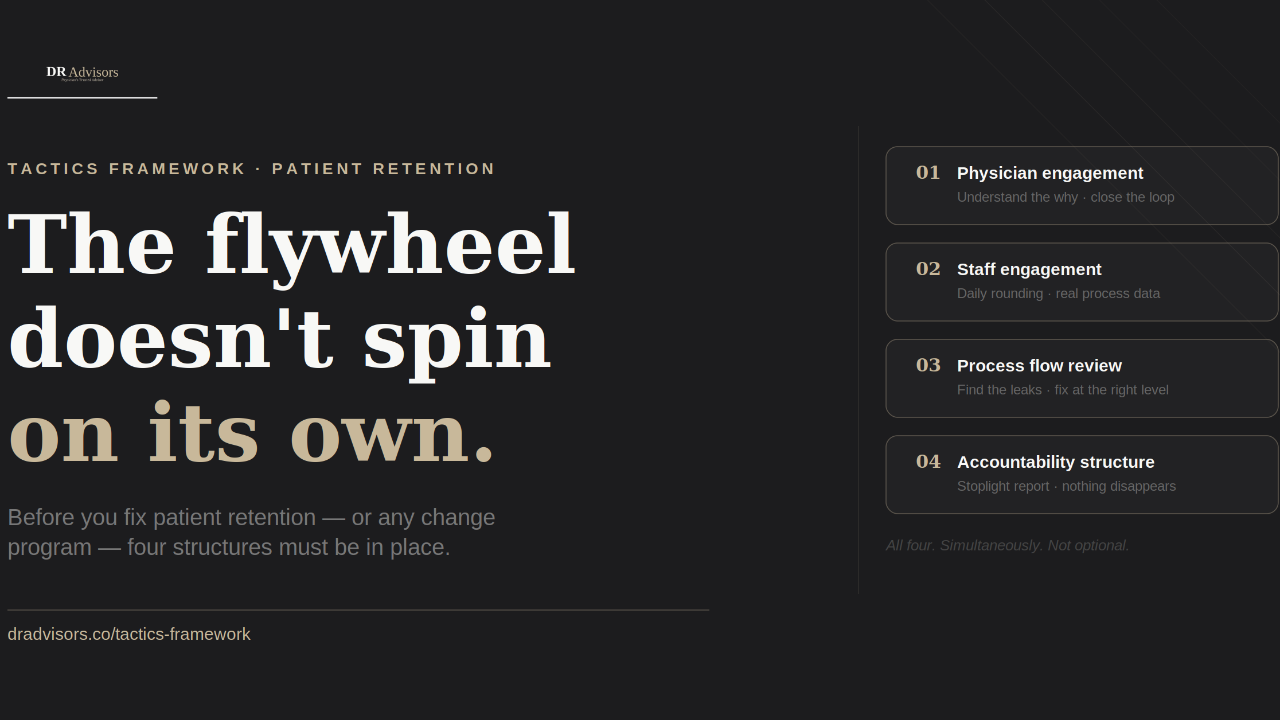
The complaint
When I started working with a primary care practice group, the first Physician Operator Review told me everything I needed to know — not because the physicians had diagnosed their problem correctly, but because they hadn't.
Two complaints dominated the meeting. First, the phones were ringing constantly. The front desk was overwhelmed with inbound calls — messages, questions, medication refill requests. The physicians believed they needed to hire more staff to handle the volume.
Second, patients were struggling to get follow-up appointments. The schedule was perpetually full, and when patients called to book a return visit, they couldn't get in within a reasonable window.
At the surface, these looked like two separate operational problems: a staffing problem and a scheduling capacity problem. The proposed solution — hire more phone staff and figure out how to open more slots — made intuitive sense.
But something didn't add up. I started asking why.
The why chain
The Physician Operator Review is designed for exactly this: structured conversation with physician leaders, using real operational data as the starting point. Not a complaint session — a diagnostic process.
We started with the phones.
Why are the phones ringing so much? A lot of patients are calling for medication refills and general messages.
Why are so many patients calling for refills? Because their prescriptions are running out before they've been seen again.
Why are prescriptions running out before the next appointment? Because patients can't get a follow-up appointment in time. The schedule is too full.
Why is the schedule too full to accommodate follow-up patients? Because patients are calling to book follow-ups instead of being scheduled before they leave.
Why aren't patients being scheduled before they leave? They should be.
The physicians got a little restless with the questions. By the third or fourth 'why,' the room felt the pressure of the direction we were heading. But when the answer landed, they recognized it immediately. It was right.
Nobody was rebooking patients at checkout. A patient who needed to return in three months was being told to call when they were ready. When they called, the schedule was already full — booked out with the patients who had managed to get through. So they waited. Their medication ran out. They called again, this time for a refill. That call tied up the phone line, delayed response times, and pushed the follow-up appointment even further out.
Two problems. One root cause. One checkout workflow that wasn't happening.
The results
The fix required physician buy-in, a workflow change, staff training, and an accountability structure to make it stick — which we'll cover in the next three posts in this series. But the outcome of getting it right was significant.
50% Reduction in inbound call volume — calls cut in half once patients were pre-scheduled
60%→95% Reappointment rate — from six in ten patients returning to nearly all of them
10% Volume growth that year — without adding a single physician to the group
None of that required a new hire. It didn't require a technology investment. It didn't require a consultant to redesign the practice model. It required one consistent behavior: booking the return appointment before the patient walked out the door.
The data was available the whole time. The operational cost of not rebooking was visible in the call volume, the schedule fill rate, and the revenue per physician. It just hadn't been connected to its cause until the right questions were asked in the right room.
What the Physician Operator Review actually does
The Physician Operator Review is not a status meeting. It's not a forum for physicians to vent about what's wrong (though that happens). It's a structured monthly meeting where operational data — volume, patient satisfaction scores, scheduling metrics, open improvement projects — creates the foundation for a diagnostic conversation.
The format matters. When physicians bring a concern into that meeting, the job of leadership isn't to validate the proposed solution. It's to ask why until the root cause is visible. Most of the time, physicians know exactly what the symptom is. They've been living with it. What they don't always know — and what they can't always see from inside the clinical work — is where the problem actually starts.
That's not a failure of the physicians. It's a structural gap. Clinicians are trained to treat what's in front of them. The Physician Operator Review creates the space to look upstream — to trace the symptom back to its source before committing to a solution.
In this case, the physicians were right that the phones were a problem. They were right that scheduling was a problem. They were proposing a solution — more staff — that would have addressed the symptom without touching the cause. More phone staff would have answered more refill calls. The reappointment rate would have stayed at 60%. The volume would have stayed flat. And the practice would have carried the cost of additional headcount to manage a problem that a checkout workflow change would have solved for free.
What comes next in this series
Knowing the root cause was only the first step. Implementing the fix required three additional components — the same four structures we covered in the previous post, now applied to a real case.
Post 2 of this series will cover staff engagement: how we brought the front desk team into the solution, why their involvement was essential to making the rebook process work, and what happened when it didn't go smoothly at first.
Post 3 will cover the process flow review: the specific workflow changes that made consistent rebooking possible, and how we categorized what needed to change immediately versus what required a more formal implementation process.
Post 4 will cover the accountability structure: how we tracked reappointment rates, what the stoplight report looked like for this initiative, and how physician visibility into the data sustained the change over time.
Each of these posts stands on its own. Together, they show how the four structures from the TACTICS Framework work in a real organization, on a real problem, with real results.
If this pattern sounds familiar in your organization — complaints that have obvious-sounding solutions that never quite fix the problem — that's often a sign that the root cause hasn't been found yet.
The Physician Operator Review is the structure that finds it. The TACTICS Framework builds that structure — and the three that follow — inside your organization.
Learn more about how the TACTICS Framework works: https://www.dradvisors.co/tactics-framework
Book a free strategy call: Free Strategy Call