The Physician Interview Follow-Up That Actually Gets You Remembered — Why Generic Thank You Notes Don't Work
Jun 16, 2026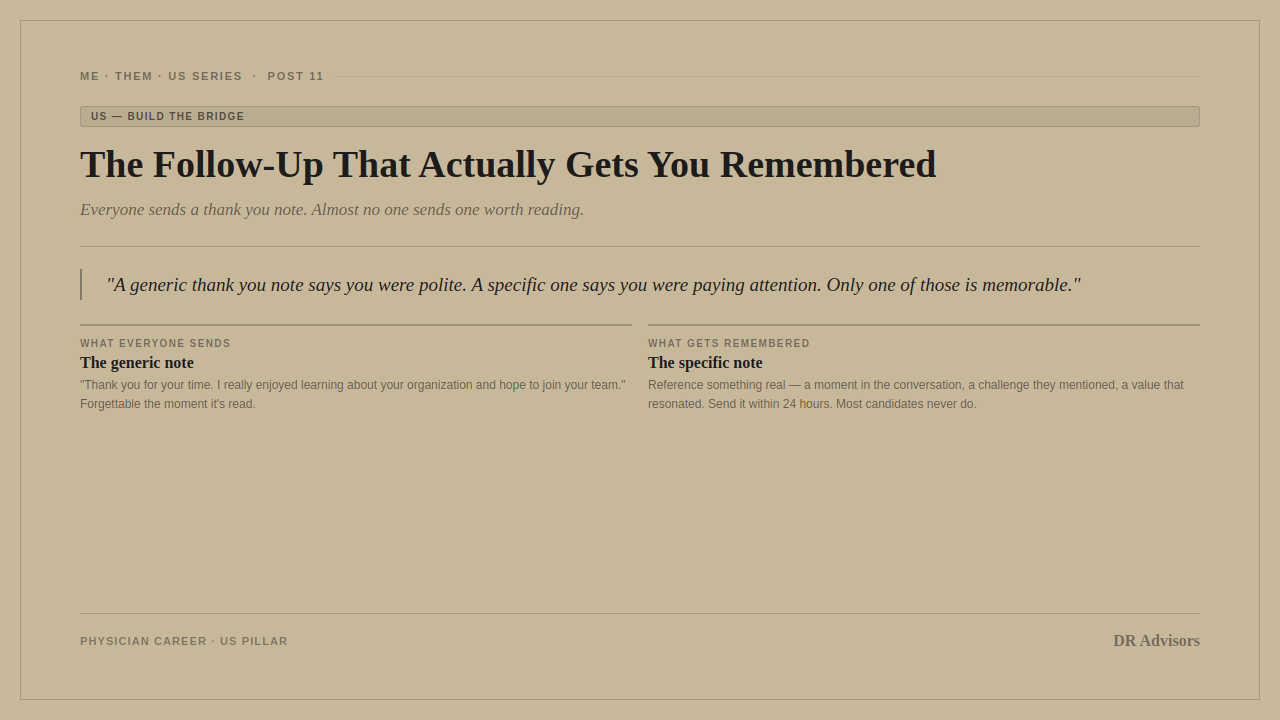
The Follow-Up That Actually Gets You Remembered — And Why Most Candidates Miss It Completely
Let me tell you something that happens after almost every physician site visit: thank you notes arrive. Sometimes the same day, sometimes the next morning, occasionally a week later when they've lost most of their impact. The hiring team reads them, nods, and moves on.
Because most of them say the same thing.
"Thank you so much for the opportunity to visit. I really enjoyed learning about your organization and meeting the team. I am very excited about this opportunity and hope to join you."
Polite. Correct. But completely forgettable.
The note that gets read twice — the one that gets forwarded to a colleague with "did you see this?" — looks nothing like that. And the gap between the two is not effort. It is specificity.
Expert Advice: "A generic thank you note says you were polite. A specific one says you were paying attention. Only one of those is memorable."
EVERYONE SENDS A NOTE. ALMOST NO ONE SENDS ONE WORTH READING.
The thank you note is one of the most underused tools in the physician job search. Not because physicians don't send them — most do (well maybe half). But because the vast majority treat it as a formality rather than an opportunity. A box to check rather than a door to keep open.
Here is what a generic note communicates: I know I'm supposed to do this.
Here is what a specific note communicates: I was fully present during our conversation, I took in what you told me, and I've been thinking about it since I left. Those are very different signals. And hiring committees — even if they can't articulate why — feel the difference.
Reading about interviewing and doing it are different skills, and the gap between them only shows up out loud. So test it. In a free fifteen-minute mock I will ask you one question cold, tell you honestly how the answer landed, and say which of my services is actually worth your money — including none of them, if that is the answer. Book the fifteen minutes and find out where you stand before it counts.
WHAT MAKES A FOLLOW-UP NOTE ACTUALLY WORK
It references something specific from your conversation. Not the organization in general. Not the role in general. A specific moment, a specific comment, a specific challenge someone shared. "You mentioned the department is working through the transition to a new care model — I've been thinking about that conversation since I left, and I wanted to share..." That sentence tells the reader you were listening. Most candidates were not.
It connects that moment to something genuine about you. The best follow-up notes don't just acknowledge what was said — they extend the conversation. They offer a thought, a relevant experience, or a perspective that shows you've continued thinking about the role since the interview ended. That continuation signals engagement that goes beyond the visit itself.
It is sent within 24 hours. The window is short. A note that arrives three days after a site visit has lost the momentum of the conversation. A note that arrives the same evening or the following morning lands while the memory is still fresh and the hiring discussion is still active. Timing matters.
It is personalized to each person you met. If you met with five people, send five different notes. Each one should reference something specific from that individual conversation. This is not as difficult as it sounds — if you were genuinely present during each meeting, you will have material. And the fact that you wrote five individual notes rather than one mass message will not go unnoticed.
THE NOTE MOST CANDIDATES NEVER THINK TO SEND
Beyond the individual thank you notes, consider a follow-up to the hiring leader that goes one step further. After your site visit, if you've done your research and you're genuinely interested in the role, send a brief note that explicitly connects what you learned on the visit to why you are the right fit — specifically. Not generally enthusiastic. Specifically aligned.
This is the US work in written form. It bridges ME and THEM into a single, clear statement: here is what I learned about you, here is what I know about myself, and here is why those two things belong together.
Most candidates skip this entirely. Which means the ones who don't skip it are remembered long after the visit is over.
Send the note. Make it specific. Send it within 24 hours. And mean every word of it.
DR Advisors · Physician's Trusted Advisor · Part of the ME · THEM · US Series
Related reading: Find the One Impressive Thing: How Physician Candidates Can Turn Interview Prep Into Real Connection | The Physician Interview Questions That Make You Look Like the Right Candidate | ME · THEM · US: The Physician Interview Framework That Wins Offers and Builds Careers