
Interview People in the Jobs You Might Want — Before You Need One: Career Advice for Physicians
Jun 04, 2026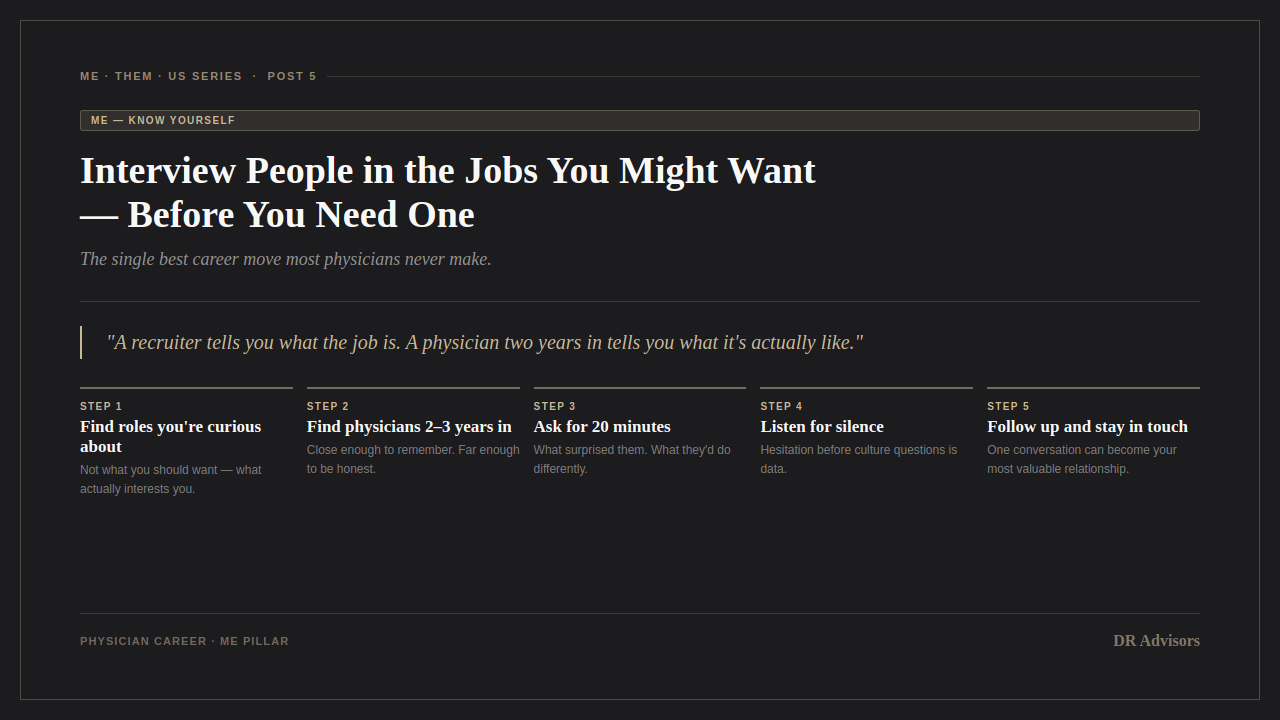
Interview People in the Jobs You Might Want — Before You Need One
Here is advice I give to every physician I work with, regardless of where they are in training: start having career conversations now. Not when you're six months from finishing residency. Not when your contract is up. Now.
The best career intelligence in medicine doesn't come from job postings, recruiters, or program directors. It comes from physicians who are already doing the job you think you might want — two or three years in, past the honeymoon period, living the real version of the role. Those conversations are available to you at any stage of your career. Most physicians simply never think to have them.
Expert Advice: "A recruiter will tell you what the job is. A physician two years into it will tell you what it's actually like. Only one of those conversations will prepare you to make a great decision."
This is not a radical idea. It's standard practice in almost every other professional field. Lawyers, consultants, and business leaders build career intelligence through deliberate conversation long before they're actively searching. Physicians, trained to keep their heads down and finish, rarely develop this habit — and they pay for it when the job search finally arrives. I developed the Me / Them / Us Framework for Physician Interviews for this very reason. I interviewed too many physicians that did not understand what they wanted to do, and that shows a lack of preparation.
If you want to Walk In Prepared. Walk Out With the Offer. Check out our Physician Interview Coaching service.
HOW TO DO IT — IN FIVE STEPS
-
Identify two or three roles you're genuinely curious about: Not roles you think you should want — roles that actually interest you. Academic vs. private, employed vs. independent. Pick the settings you find yourself thinking about and start there.
-
Find physicians who are two to three years into those roles: Not senior partners who've forgotten what year one felt like. Physicians close enough to the transition to remember it clearly — and far enough in to have an honest perspective. Alumni networks, LinkedIn, and program directors are all good starting points.
-
Ask for 20 minutes — and come with real questions Most physicians will say yes to a short, focused conversation with a trainee or early-career colleague. Don't waste it on questions you could answer with a Google search. Ask what surprised them. Ask what they'd do differently. Ask what Tuesday at 2pm actually looks like.
-
Listen for what they don't say as much as what they do: Enthusiasm is informative. So is hesitation. When a physician pauses before answering a question about culture or autonomy, that pause is data. You're not just collecting information — you're learning to read a practice setting before you're inside it.
-
Follow up and stay in touch. A thank-you note that references something specific from your conversation turns a single informational interview into the beginning of a professional relationship. These are the people who will refer you, advocate for you, and tell you when a position opens up before it's posted anywhere.
QUESTIONS THAT GET YOU REAL ANSWERS
What surprised you most in your first year that you didn't expect going in? How would you describe the culture of your group to someone who had never met any of you? What does a typical week actually look like — not the best week, the typical one? If you were making this decision again, what would you do differently? What kind of physician thrives here — and what kind tends to struggle? Is there anything you wish someone had told you before you took this role?
Notice what these questions have in common: they invite honesty rather than a sales pitch. They signal that you're a thoughtful, self-aware physician who is doing real due diligence — not just collecting offers. That reputation follows you. The physicians you interview today may be the colleagues, references, or hiring leaders you encounter tomorrow.
Have a question this post did not answer? Bring it to a free fifteen-minute call — interviewing, negotiating or contracts.
Start these conversations before you need them. The intelligence you build now will shape every decision you make later. And the relationships you build in the process may turn out to be the most valuable career assets you have.
That's the ME work at its most practical. Know what you want — by talking to the people already living it.
DR Advisors · Physician's Trusted Advisor · Part of the ME · THEM · US Series
Related reading: Academic vs. Private Practice: The Physician Career Decision Framework Residency Never Taught You | How to Research a Health System Before Your Physician Site Visit | The Physician Interview Questions That Make You Look Like the Right Candidate