
The Story of Me: How Physicians Can Articulate Their Clinical Identity in a Job Interview
Jun 02, 2026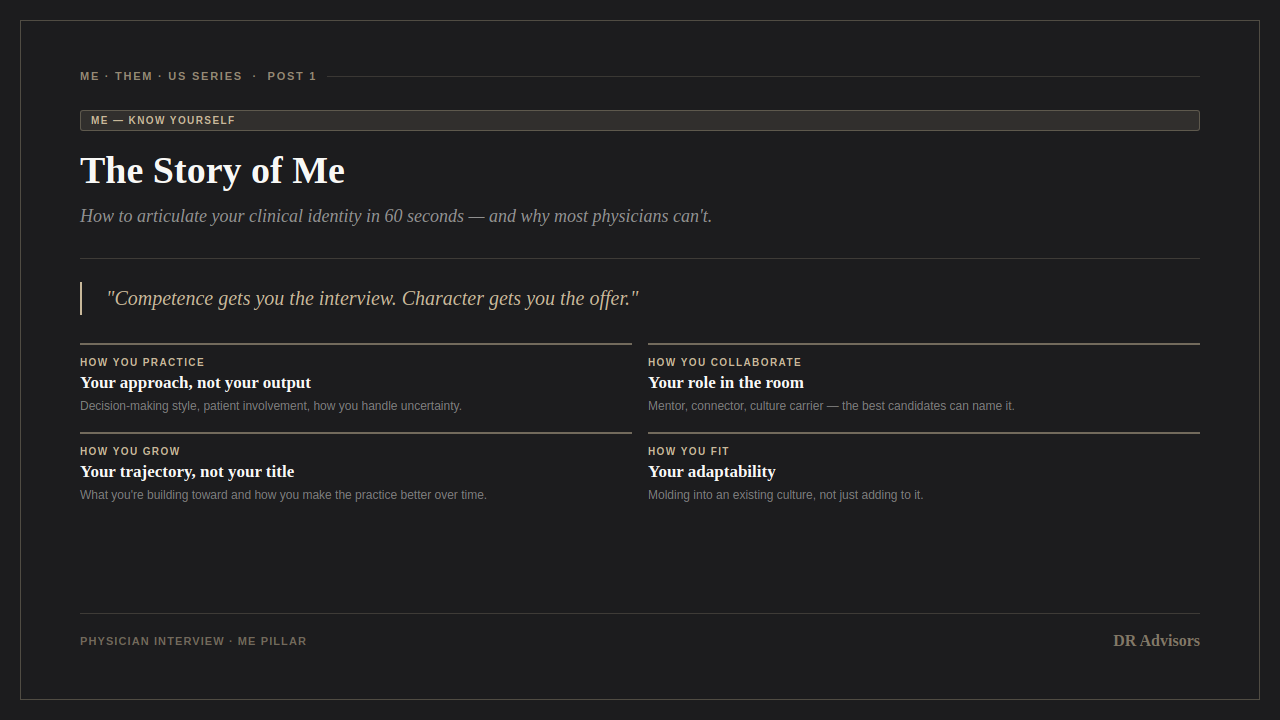
Medical training is extraordinarily good at one thing: teaching physicians to describe what they do. Procedures mastered. Conditions treated. Volumes handled. By the time a physician sits across from a hiring committee, they can recite their clinical capabilities with precision and confidence.
But that's not what the room is waiting to hear.
What every hiring leader actually wants to know — and rarely gets a direct answer to — is something much simpler and much harder: What kind of colleague will you be? This is why I developed the Me / Them / Us Framework for Physician Interviews
From experience · DR Advisors
We interviewed an interventional cardiologist who looked excellent on paper — strong training, impressive procedural volume, clearly capable of doing the clinical work at a high level. But as the conversation unfolded, something kept pulling us back to the surface.
Every time we moved toward culture, team dynamics, or how this physician might grow within the group, the answer redirected to procedures. What they could do. What they would bring technically. The clinical credentials were real — but the person behind them never quite showed up.
And the questions that started forming in the room were not clinical ones.
Would this physician roll up their sleeves when the team needed it — or would they consider certain work beneath them? Would they do the things we ask every member of this group to do, regardless of seniority? Would they be someone we actually enjoyed coming to work with every day?
Culture was not a secondary consideration for this team — it was central to everything we had built. And sitting in that room, I couldn't find a way to see this physician fitting into it without leaving a mark on it. Not through any malicious intent. But through a fundamental mismatch between who they were and what we had spent years cultivating.
They didn't get the offer. Not because they weren't talented. But because no one in that room could picture working alongside them — and that answer, once it's in the room, doesn't go away.
This is not a rare story. I've watched versions of it play out across specialties, across practice settings, across career stages. Highly trained physicians who can describe their work but struggle to articulate themselves as people, as partners, as colleagues.
It's not a character flaw. It's a training gap. Medicine teaches you to lead with credentials. Interviews reward something else entirely.

WHAT CLINICAL IDENTITY ACTUALLY MEANS
Your clinical identity is not your procedure list. It's the intersection of how you practice, how you think, and how you show up for the people around you.
How you practice — Your approach, not your output. Are you conservative or aggressive in your decision-making? Do you involve patients deeply in their care? How do you handle uncertainty? These answers reveal character, not just competency.
How you collaborate — Your role in the room. Do peers come to you for clinical judgment — or for something beyond that? Are you a mentor, a connector, a culture carrier? The best candidates can name it.
How you grow — Your trajectory. How do you learn? How do you make the people and the practice around you better over time?
How you fit — Your adaptability. Can you speak to how you'd integrate into an existing culture — not just what you'd add to it? The best candidates show they've thought about molding in, not just standing out.
BUILDING YOUR 60-SECOND ANSWER
Before your next interview, write out the answer to this one question — in full sentences, not bullet points:
"What kind of colleague will you be?"
This is the question behind every "tell me about yourself" you'll ever be asked. Answer it directly — with a specific story, a clear value, and a concrete picture of how you show up for the people around you. Practice it until it sounds like a conversation, not a presentation.
Your answer should cover three things in 60 seconds or less: who you are as a clinician, not your training; how you show up for your team, not what they can do for you; and how you will fit in the culture of the group. Not your CV. Not your procedure volume. You.
The physicians who get offers — and more importantly, who build their careers on relationships — are the ones who walk into the room already knowing the answer. They don't wait to be asked. They've done the ME work. And it shows.
That's where this series starts. Know yourself first. Everything else follows from there.
The interview is not a test you pass. It is the first conversation with people deciding whether they want you in the room for the next ten years, and the physicians who do it well walk in already sounding like a colleague who simply hasn’t started yet. That is what ME + THEM = US is for: know what you want, know who you are meeting, and say out loud where the two meet. If you want to work it that way, there are three ways to do it with me — the preparation course at your own pace, a mock interview to test it, or coaching where we build the whole thing together.
DR Advisors · Physician's Trusted Advisor · Part of the ME · THEM · US Series
Related reading: ME · THEM · US: The Physician Interview Framework That Wins Offers and Builds Careers | Academic vs. Private Practice: The Physician Career Decision Framework Residency Never Taught You | Your Medical Training Got You the Interview. It Won't Get You the Offer.