
Stop Answering What They Said — Answer What Physician Interviewers Actually Mean
Jun 25, 2026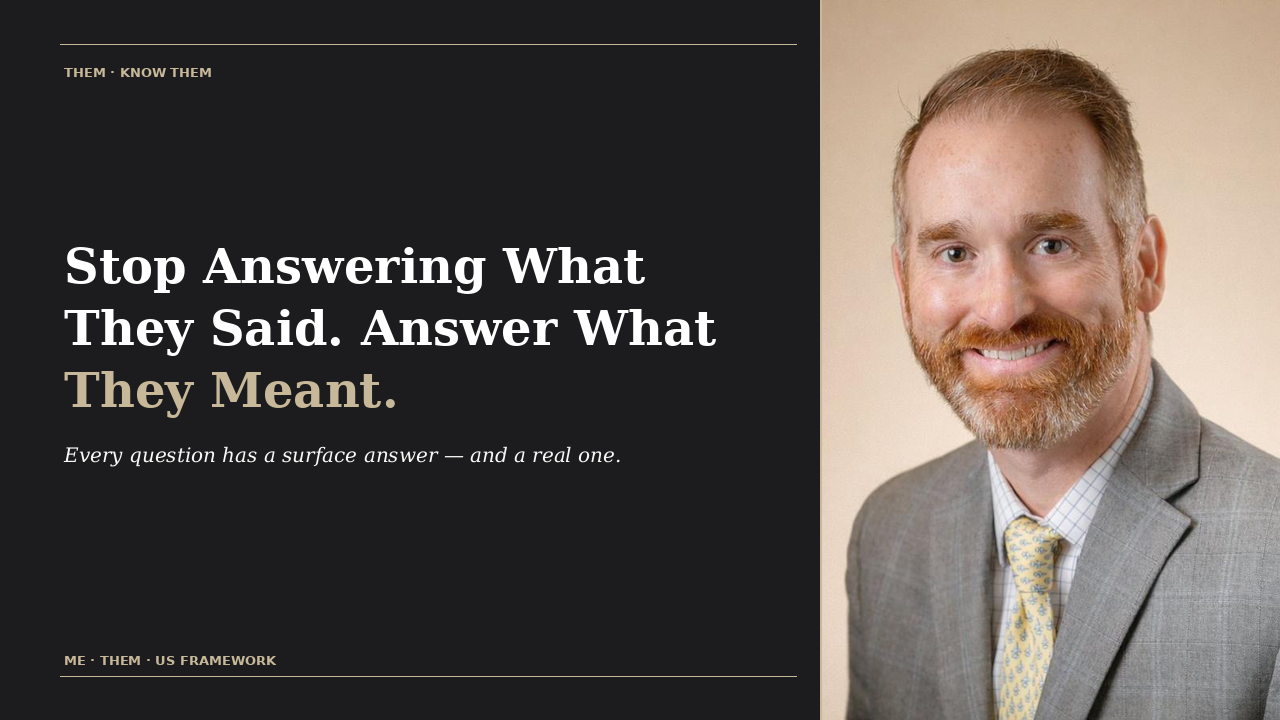
Every interview question has a surface answer — and a real one.
You are sitting across from the interview panel. They ask you a question. And somewhere in the back of your mind you are thinking: what are they actually trying to find out right now?
That instinct is exactly right. Most candidates never learn how to act on it.
What Nobody Tells You About Physician Interview Questions
Here is what nobody tells you: every question in a physician interview has a surface answer and a real answer. The interviewer is not always asking what they appear to be asking. And the candidates who understand this walk out of the room with the offer.
Let us walk through the three most common examples.
"Tell Me About Yourself"
This is not an invitation for your life story. It is not a prompt to walk them through your CV. They already have your CV.
What they are really asking is: are you self-aware enough to know what matters in this room? Can you read your audience and speak to what is relevant? Do you understand what this opportunity is, and do you know why you belong here?
The candidate who gives a chronological summary of their training is answering the surface question. The candidate who opens with a clear, compelling statement of clinical identity — and connects it immediately to why this organization and this role are the right next step — is answering the real question.
"Where Do You See Yourself in Five Years?"
This is not about your ambitions. They do not actually need a five-year career plan from you right now.
What they are really asking is: are you going to commit to this role, or are you using it as a bridge to something else? Are you here for us, or are you here for a line on your CV?
The wrong answer talks about leadership tracks or specialty pivots. The right answer demonstrates genuine investment in this role and this team, with a vision for how to grow and contribute within this specific environment.
"What Is Your Biggest Weakness?"
This is not a trap. And it is not an invitation to give a fake weakness disguised as a strength.
What they are really asking is: do you have the self-awareness that makes someone coachable? Can you acknowledge your growth edges without defensiveness? Are you the kind of person who is going to be honest and easy to work with?
The candidate who says "I work too hard" is answering the surface question — and failing the real one. The candidate who names something genuine, explains the context, and describes how they are actively working on it is demonstrating exactly the kind of character that hiring leaders want on their team.
How to Read the Room
The Me / Them / Us Framework for Physician Interviews gives you the foundation for this. When you have done your THEM research — when you genuinely understand the organization's mission, their culture, and what success looks like in this role — you can hear what is underneath the question.
You stop performing and start connecting. The people across the table stop evaluating you and start imagining what it would be like to work with you every day. That shift is the difference between a candidate who was impressive and a candidate they have to hire.
Expert Advice: Before your interview, write down what you think the real question is behind each major interview question. "Tell me about yourself" → "Why are you the right person for this specific role?" "Where do you see yourself in five years?" → "Will you commit to us?" Training yourself to hear the underlying question changes how you respond in the room.
Preparation fails for a boring reason: it never gets scheduled. A week out from the interview there is clinic, there is call, and the research you meant to do turns into twenty minutes in the parking lot. So make it small enough to actually happen — one decision a day for seven days, in order, each one taking less time than a note. The seven-day plan lays out exactly what that day’s move is, so the thinking is done before the room.
DR Advisors · Physician's Trusted Advisor · Part of the ME · THEM · US Series
Related reading: Two Questions Residents Ask That Instantly Kill Their Physician Interview | The Story of Me: How Physicians Can Articulate Their Clinical Identity in a Job Interview | Find the One Impressive Thing: How Physician Candidates Can Turn Interview Prep Into Real Connection